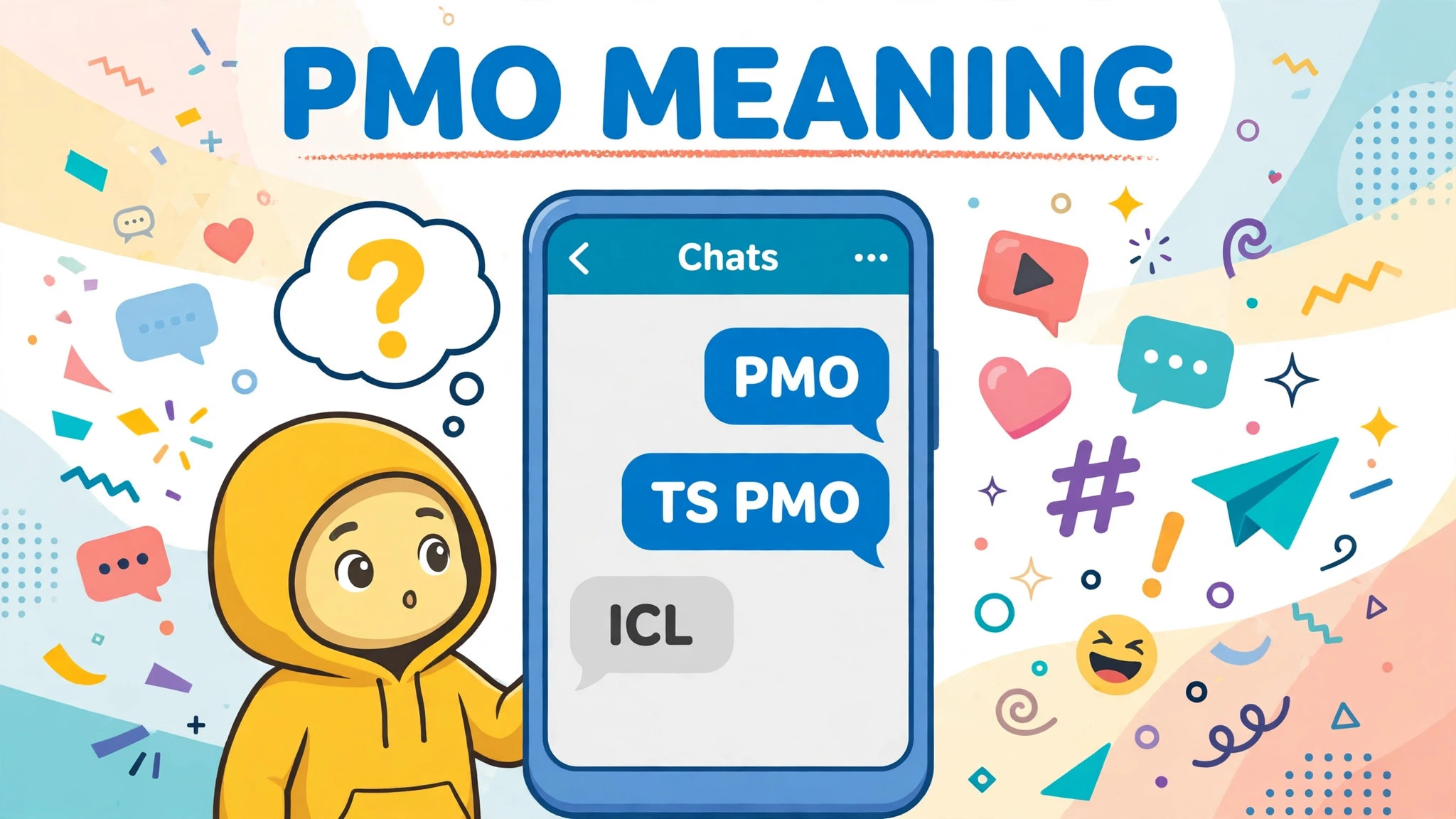
If someone texts you “pmo” or you keep seeing it in TikTok comments, most of the time today PMO means “piss me off” or “pisses me off” — something is annoying the person, usually said jokingly rather than in real anger. PMO also has a second, completely different meaning: “put me on,” meaning “introduce me to that” or “recommend that to me.” This guide explains both meanings, what “TS PMO” and “TS PMO ICL” mean, and how to use and reply to PMO correctly.
PMO at a Glance
| You saw this | It means | Plain-English translation |
|---|---|---|
| PMO | Piss me off / pisses me off | That annoys me |
| PMO | Put me on | Introduce me to that / recommend it to me |
| TS PMO | This sh*t pisses me off | This thing is really annoying me |
| TS PMO ICL | This sh*t pisses me off, I can’t lie | Honestly, this is really annoying me |
Quick rule: if the person sounds annoyed, it is “piss me off.” If they sound interested, it is “put me on.”
What Does PMO Mean?
PMO is a three-letter slang abbreviation with two established meanings. The first and now most common is “piss me off” — also written as “pisses me off,” “pissing me off,” or “pissed me off,” depending on the sentence. It is a short way of saying that a person, situation, or thing is getting on your nerves.
The second meaning is “put me on.” To “put someone on” means to introduce them to something new — a song, a show, a product, or even a person — or to share useful information with them.
The two meanings are almost opposites in mood: one is a complaint, the other is a request. Fortunately, the words around PMO almost always give away which one is meant.
PMO Meaning in Text Messages
In texting and DMs, PMO works as a reaction more than a complete sentence — the way someone might say “ugh.” You will usually see it in lowercase, attached to whatever is causing the frustration:
- “The Wi-Fi went down again, pmo”
- “He read my message and never replied. Actually pmo.”
In this setting, PMO is rarely as serious as it sounds. Friends use it for small, everyday annoyances: a phone dying at 20%, an ad longer than the video, a sibling borrowing a charger without asking. The tone is normally playful complaining between people who know each other well. The “put me on” meaning also appears in texts, but usually aimed at something specific — “pmo to that restaurant you posted” — which makes the request easy to spot.
PMO Meaning on TikTok
TikTok is where PMO became a viral term. In late 2024 and early 2025, it spread widely in the “piss me off” sense, appearing in captions, on-screen text, and comment sections — often stacked with other abbreviations (more on that below).
On TikTok, PMO is typically used in three ways:
- Venting for comedy. A creator films a minor annoyance — a slow line, a glitching app, a ruined snack — and captions it “ts pmo.”
- Reacting in comments. Viewers reply “pmo” or “don’t pmo” under a frustrating or cringeworthy video.
- Asking for recommendations. Under a music, fashion, or food video, “pmo” can mean “put me on” — the commenter wants the song name, product link, or recipe.
A laughing emoji and a silly video usually signal a joke; a question about where something came from usually signals “put me on.”
The Other Meaning: “Put Me On”
“Put me on” is the older social meaning of PMO in spoken slang, and it is entirely positive. When someone says “pmo,” they are asking you to share something good with them or connect them with someone:
- Music: “That song in your video is great — pmo.”
- Fashion and shopping: “Where are those sneakers from? PMO.”
- Shows and movies: “Everyone keeps talking about that series, someone pmo.”
- Introductions: Asking a friend to connect you with a coworker, a creator, or another useful contact.
The clue is direction: “put me on” comes with a request or question — the person wants a link, a name, or an introduction. If nobody is asking for anything and the mood is irritation, read PMO as “piss me off.”
What Does TS PMO Mean?
TS PMO is the viral combination that pushed PMO into the mainstream. It breaks down like this:
- TS = “this sh*t” (or “that sh*t”)
- PMO = “piss me off” / “pissing me off”
Put together, “TS PMO” means “this sh*t pisses me off.” People use it to react to something irritating or ridiculous — a bad call in a game, an annoying video, a frustrating piece of news.
Part of the joke is that the phrase is often used loosely, even incorrectly, on purpose. If you see “ts pmo” plastered across a video that does not seem annoying at all, that is intentional — the exaggeration is the humor.
What Does TS PMO ICL Mean?
TS PMO ICL adds one more abbreviation to the stack:
- TS = “this sh*t”
- PMO = “piss me off”
- ICL = “I can’t lie”
The full translation is: “I can’t lie, this sh*t pisses me off” — in natural English, “Honestly, this is really annoying me.”
This three-part stack became a viral TikTok format in late 2024 and early 2025, sometimes called “slang overload.” Users filled entire screens and comment sections with walls of abbreviations, partly to express a feeling and partly as absurdist humor. The trend also started a wider conversation: these abbreviations grew out of African American Vernacular English (AAVE) used by Black internet communities for years, and some users raised concerns that the ironic overuse strips the terms of their original meaning and credit — worth keeping in mind before jumping on the trend yourself.
How to Use PMO in a Sentence
Here are natural examples of PMO in both meanings, so you can see the difference context makes:
| Example sentence | Meaning used | What the person is saying |
|---|---|---|
| “Slow walkers in the middle of the hallway pmo.” | Piss me off | Slow walkers annoy me. |
| “Don’t pmo today, I’m already in a bad mood.” | Piss me off | Don’t annoy me today. |
| “My phone died right before I could save my work — pmo fr.” | Piss me off | My phone dying really annoyed me, for real. |
| “This update deleted my playlists. Actually pmo.” | Piss me off | This update genuinely annoyed me. |
| “Wait, that ending?? The cliffhanger pmo.” | Piss me off | That cliffhanger frustrated me. |
| “Your playlist is amazing, pmo.” | Put me on | Recommend me songs like these. |
| “Where did you get that jacket? PMO!” | Put me on | Tell me where to get that jacket. |
| “He pmo to that barber and I have never gone anywhere else.” | Put me on | He introduced me to that barber. |
| “Pmo to some good study music, I can’t focus.” | Put me on | Suggest some good study music. |
| “She put me on to that podcast last week.” (written out) | Put me on | She introduced me to that podcast. |
The pattern: complaints point to “piss me off”; questions, compliments, and requests point to “put me on.”
How to Reply to PMO
The right reply depends on which meaning the sender used:
If they mean “piss me off”:
– Show sympathy: “No because same, that is so annoying.”
– Add humor: “It pmo too, you’re not alone 😭”
– Keep it short: “Fr” (for real), “Real,” or simply agree and share your own example.
If they mean “put me on”:
– Just share the thing: send the song link, product name, store, or recipe they are asking about.
– Name the source: “The song is in my caption,” or “My cousin did my hair, I’ll send her page.”
– If they want an introduction, offer to connect them: “I got you, I’ll send them your @.”
If you genuinely cannot tell which meaning was intended, it is fine to ask — “Wait, annoyed or you want the link?” A quick clarification beats a confident wrong answer.
PMO vs Similar Slang
PMO is often seen alongside other honesty and reaction abbreviations. Here is how they compare:
| Slang | Full form | Meaning | Typical use |
|---|---|---|---|
| PMO | Piss me off / Put me on | “That annoys me” or “introduce me to that” | Venting, or asking for a recommendation |
| ICL | I can’t lie | “Honestly” / “I have to admit” | Starting a confession or honest opinion |
| NGL | Not gonna lie | “Honestly” | Softening an honest or blunt statement |
| TBH | To be honest | “Honestly” | Giving a sincere opinion, rating, or compliment |
The key difference: ICL, NGL, and TBH all mean “honestly” — they frame an opinion. PMO instead expresses a feeling (annoyance) or makes a request (a recommendation). That is why they stack so naturally: “ICL” supplies the honesty, “PMO” supplies the feeling — “ICL, ts pmo.”
If you enjoy decoding abbreviations like these, our guide to FWIW meaning explains another one you will see in texts every day.
When NOT to Use PMO
PMO is casual slang, and its most common meaning contains the word “piss,” which is mild profanity. That limits where it belongs:
- At work or school: Avoid PMO in emails, assignments, and messages to managers or teachers. Many readers will not know it — and in a professional setting, PMO usually means something else entirely: Project Management Office.
- With people you do not know well: A joking “don’t pmo” can read as genuinely rude to someone who does not know your tone.
- In serious complaints: Clear words work better than slang. “I was frustrated because…” gets taken seriously; “pmo” does not.
- Around formal family settings: Grandparents may not understand it, and younger children should not repeat it.
A safe rule: if you would not say the full phrase “piss me off” in that conversation, do not abbreviate it either.
Origin of PMO
PMO was not invented by TikTok — the app only made it famous. According to Know Your Meme, the earliest known definition of PMO as “pisses me off” was posted to Urban Dictionary on December 20, 2005, and the term was used online in that sense consistently through the 2000s and 2010s, including on Twitter.
The “put me on” meaning was defined on Urban Dictionary later, on July 27, 2016, and Know Your Meme notes it is unclear who first used the acronym that way. It then spread on TikTok in the early 2020s: a 2021 trend built around “PMO to your…” had users showing off friends and partners, and the sense was popularized on the platform in 2022.
Know Your Meme also notes PMO was used earnestly for years mostly by Black internet users, as part of internet AAVE lingo. In late 2024 and early 2025, the “piss me off” meaning went newly viral, got stacked with TS and ICL in the “slang overload” memes, and reached the huge audience that knows it today.
The phrase shows up in forum discussions too — in this Reddit thread about PMO meaning, a user who kept seeing “pmo” in TikTok comments asks what it means, and commenters explain both meanings and stacks like “icl ts pmo.”
Frequently Asked Questions
What does PMO mean in text?
In text, PMO most commonly means “piss me off” or “pisses me off,” used to say something is annoying.
Depending on context, it can also mean “put me on,” meaning “recommend that to me” or “introduce me to that.”
What does PMO mean on TikTok?
On TikTok, PMO usually means “piss me off,” especially in captions and comments reacting to something frustrating. It appears in the viral stacks “TS PMO” and “TS PMO ICL,” but can also mean “put me on” when someone asks for a song, product, or recommendation.
What does TS PMO mean?
TS PMO means “this sh*t pisses me off.” TS stands for “this sh*t” and PMO stands for “piss me off.” It is used — often jokingly — to react to something irritating or ridiculous.
Is PMO a bad word?
PMO is not among the strongest swear words, but its main meaning contains “piss,” which is mild profanity. It is fine among friends online, but not appropriate for work, school, or formal situations.
How do you pronounce PMO?
PMO is usually typed rather than spoken. When said aloud, people say the letters — “pee-em-oh.”
What is the difference between PMO and ICL?
PMO expresses annoyance (“piss me off”) or a request (“put me on”), while ICL means “I can’t lie” and signals honesty. They are often combined: “ICL ts pmo” — “I can’t lie, this sh*t pisses me off.”
Conclusion
PMO is a small abbreviation carrying two very different messages. Most of the time in 2026, it means “piss me off” — a playful way to vent about life’s small annoyances, especially on TikTok, where “TS PMO” and “TS PMO ICL” turned it into a viral catchphrase. In the right context, though, the same three letters are a compliment and a request: “put me on” — share that song, that place, that discovery with me.
Once you learn to read the mood around it, PMO stops being confusing: complaints mean one thing, curiosity means the other. If you enjoy exploring the words and names behind the trends, you might also like our breakdown of the Declan meaning.