
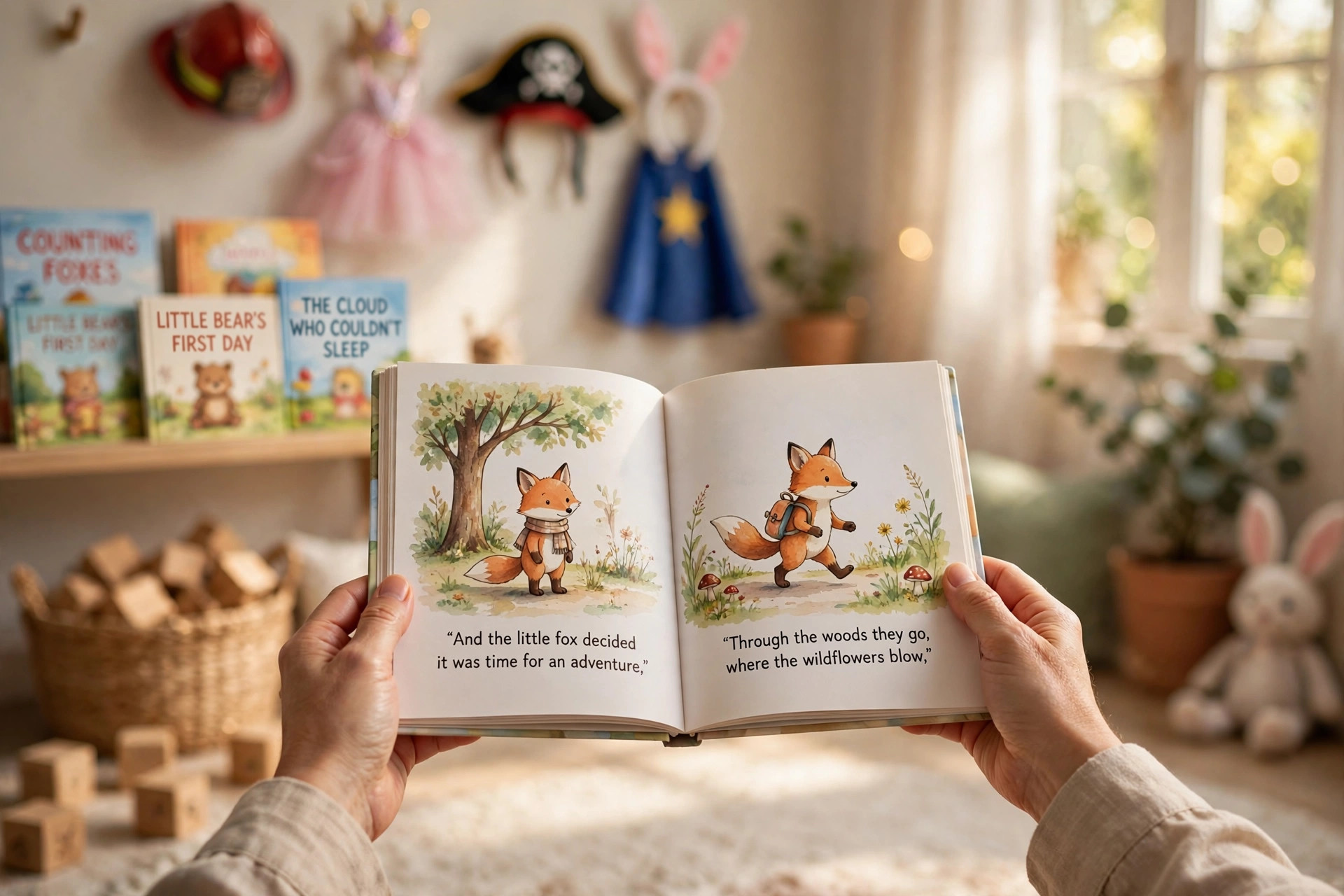
Nursery school storytelling and creative play are not breaks from learning — for young children, they are how learning happens. A story gives a child new words in a context that makes them memorable. Pretend play gives those words a job to do: negotiating who plays the shopkeeper, explaining why the block tower fell, or inventing what happens next. England’s Early Years Foundation Stage (EYFS) framework puts conversation, storytelling and role play at the heart of language development, and the Education Endowment Foundation’s (EEF) evidence summaries show that interactive reading and play-based approaches can add months of progress for young children. This guide explains what storytelling and creative play actually teach, how good nurseries use them, and what parents can do at home — without worksheets, pressure, or the idea that learning only counts when it looks like school.
| Area of learning | What storytelling and play build | How it looks in a nursery |
|---|---|---|
| Communication and language | Vocabulary, listening, sentence structure, confidence to speak | Daily stories, rhymes, back-and-forth conversations, role play |
| Personal, social and emotional development | Turn-taking, empathy, managing feelings, persistence | Group pretend play, stories about feelings, negotiating roles |
| Literacy foundations | Love of books, story structure, sounds and rhymes | Shared reading, story retelling, mark-making in play |
| Mathematics foundations | Counting, shapes, size, patterns, problem-solving | Block building, shop play, sorting games, cooking stories |
| Understanding the world | Curiosity about people, places and nature | Stories from other cultures, small-world play, nature exploration |
| Physical development | Coordination, control, confidence in movement | Action songs, dance, building, outdoor imaginative play |
| Expressive arts and design | Imagination, creativity, self-expression | Painting, music, dressing up, inventing stories and songs |
Table of Contents
- Why Stories Work: Language in a Form Children Remember
- What the EYFS Framework Actually Says
- What the Evidence Shows — and What It Does Not Prove
- Building Vocabulary Naturally, Not by Drilling Words
- Pretend Play: Rehearsing Real Life in Safety
- Supporting Storytelling and Play at Home
- Frequently Asked Questions
- Conclusion
Why Stories Work: Language in a Form Children Remember
A story does several jobs at once, which is why it is such an efficient teaching tool for young children. First, it carries new vocabulary inside a meaningful context: a child who hears “enormous” describing a giant’s turnip, sees the picture, and hears the word repeated as the story unfolds, has a far better chance of remembering it than a child who is simply told the word and its definition. Second, a story gives language a structure — a beginning, a problem, a sequence of events and a resolution — and children absorb that structure long before they can name it. When they later retell the story in their own words, they are practising sequencing, cause and effect, and sentence-building without ever being taught those terms.
Third, stories let children experience emotions and situations at a safe distance. A character who feels scared, brave, lonely or proud gives a child words for feelings they may not yet be able to name in themselves, and gives adults a natural way to talk about those feelings afterwards. Fourth, stories are social: a shared story is a shared experience, and the conversation around it — “What do you think will happen?”, “Why did she do that?”, “Has that ever happened to you?” — is where much of the language learning actually happens. The story is the starting point; the talk around it is the teaching. A nursery that reads stories without conversation is getting only part of the benefit, and the same is true at home: the questions you ask during and after a story matter at least as much as the story you choose.
What the EYFS Framework Actually Says
In England, the Early Years Foundation Stage is the statutory framework for children from birth until they start Year 1, typically at age five, and it applies to Ofsted-registered settings including nurseries, preschools and childminders. It organises learning into seven areas: three prime areas — communication and language, physical development, and personal, social and emotional development — and four specific areas — literacy, mathematics, understanding the world, and expressive arts and design. The prime areas are the foundation: practitioners working with the youngest children are expected to focus strongly on them, with the balance shifting towards all seven areas as children grow in confidence.
The framework’s own description of communication and language is unusually direct about storytelling and play. It says that children’s spoken language underpins all seven areas, that the number and quality of conversations children have with adults and peers throughout the day in a language-rich environment is crucial, and that through conversation, storytelling and role play — where children share their ideas with support and modelling from their teacher, and sensitive questioning that invites them to elaborate — children become comfortable using a rich range of vocabulary and language structures. That single passage is a practical brief for any nursery: talk with children, not just to them; read frequently and actively, not passively; give children many chances to use new words in different contexts; and ask questions that invite longer answers rather than one-word replies. It also explains why the framework expects learning to be delivered through planned, purposeful play, with a balance of adult-led and child-initiated activities, rather than through formal lessons for very young children.
What the Evidence Shows — and What It Does Not Prove
Parents and practitioners are rightly suspicious of claims that any one activity “boosts” development, so it is worth stating what the EEF’s evidence summaries actually say, including their caveats. The EEF’s Early Years Toolkit summarises international evidence that communication and language approaches can improve progress by up to seven months over the course of a year for young children, and that interactive reading — where children engage with pictures, texts and questions during story time, predict what happens next, and relate stories to their own experience — is a high-impact version of that approach. Its guidance on early reading similarly finds that storytelling and shared reading activities have consistently been shown to improve children’s language comprehension skills. Those are strong findings, but “up to seven months” is an average effect expressed in months of progress, not a guarantee for any individual child, and the EEF notes that some studies show slightly larger effects for children from disadvantaged backgrounds.
Play-based learning carries a more cautious verdict. The EEF’s summary finds a moderate positive impact of around four additional months on learning outcomes on average, across early literacy, language, early numeracy and other cognitive outcomes, but it stresses that the evidence base is limited, that effects vary substantially, and that most studies focus on guided play — play shaped by a practitioner — rather than free play alone. Two studies of free play that met the toolkit’s inclusion criteria even gave conflicting results. The honest reading is therefore not “play magically teaches everything”, but “guided, language-rich play, led by adults who talk, question and extend children’s ideas, is a well-supported way to teach young children”. That distinction matters for choosing a nursery: the question is not whether children play, but whether adults join, extend and talk during that play.
Building Vocabulary Naturally, Not by Drilling Words
Young children learn words best when the word arrives at the moment it is needed. A child building a tower needs “tall”, “wobbly”, “balance” and “fall down” right now, for a real purpose, and those words stick because they solved a problem. A story works the same way: the word “gigantic” matters because the character cannot fit through the door, and the child feels the problem before learning the label for it. Good practitioners exploit this deliberately. They comment on what a child is interested in or doing, and echo back what the child says with new vocabulary added — a technique the EYFS framework describes directly. If a child says “big dog”, the adult might reply, “Yes, an enormous, fluffy dog!”, giving the child two new words attached to an idea they already own.
Repetition matters as much as novelty. Hearing a story once introduces words; hearing it several times, with chances to join in, predict lines and eventually retell it, embeds them. That is why nurseries repeat favourite stories rather than racing through new ones, and why parents should not worry that a child wants the same book every night. The fifth reading is not wasted time; it is the reading where the child starts to supply the missing words, correct the adult’s deliberate mistakes, and use the story’s language in their own play. Songs and rhymes add a further layer, because rhythm and repetition make the sounds and patterns of words easier to hear and remember, which supports the phonological awareness — hearing syllables, rhymes and initial sounds — that later underpins learning to read.
Storytelling and play build the same communication skills that later shape school applications — our guide to how students can impress review committees shows what admissions officers look for years down the line.
Pretend Play: Rehearsing Real Life in Safety
Pretend play — a cardboard box becomes a spaceship, a wooden spoon becomes a telephone, a corner of the room becomes a shop — looks like pure imagination, but it is also rehearsal. Children recreate familiar experiences (shopping, cooking, visiting the doctor, putting a doll to bed) and in doing so they practise the language, sequences and social rules of those experiences. A child playing shop must greet, ask, count, pay, thank and say goodbye, in order, and must adjust when the “customer” does something unexpected. That is a demanding cognitive task disguised as a game, and it is why small-world play — dolls’ houses, farms, garages — and role-play areas are standard equipment in good nurseries, not optional extras.
Pretend play also lets children try on identities and feelings they cannot yet live. A shy child can be a brave knight; a child who has just visited a hospital can be the doctor, in control this time. Adults support this best by providing open-ended materials — blocks, fabric, boxes, loose parts that can become many things — rather than single-purpose toys that dictate one way of playing, and by joining play occasionally as a character, not as a director. The adult who enters the shop as a customer and asks, “Have you got any apples today? How much are they?”, extends the play and its language far more than the adult who stands outside it giving instructions. The goal is not a tidy performance: group pretend play also teaches turn-taking, negotiation and empathy, as children agree roles, cope when someone changes the plot, and consider ideas that are not their own.
Supporting Storytelling and Play at Home
Parents do not need special equipment, expensive books or teaching qualifications to support this learning — they need time, talk and a willingness to be silly. Read together every day if you can, even for ten minutes, and treat the book as a conversation, not a performance: pause, ask questions, let your child interrupt, and follow their interests rather than rushing to the end. If your child wants the same book for the twentieth time, celebrate it: familiarity is how children learn to predict, join in and eventually retell. Tell stories without a book too — stories about your own childhood, about the family’s day, or invented stories where your child chooses the character and the problem. Children who invent endings, change a story’s middle, or tell you what happened at nursery in story form are practising narrative skills that matter far more than knowing any particular tale.
Make play language-rich without turning it into a lesson. Narrate what you are doing together while cooking, shopping or tidying (“We need three apples — one, two, three”), offer open-ended materials (boxes, fabric, pots, wooden spoons) alongside bought toys, and join pretend play as a character who asks questions rather than as a director who gives orders. Sing songs and rhymes, including ones from your own language and culture, because multilingual storytelling is an asset, not a problem: children who hear rich language in their home language build the narrative and vocabulary foundations that transfer to English. And keep it joyful. A child who associates stories and play with pressure, correction or testing will avoid them; a child who associates them with laughter, attention and a parent’s undivided focus will seek them out — and that appetite for stories is, in the end, the most valuable thing a nursery or a parent can build.
Practitioners swap notes on story time in a Foundation Stage Forum thread on story time for 2-year-olds, including when group stories work and when one-to-one, snuggled-up stories work better.
Frequently Asked Questions
What age is nursery school for?
It varies by country and setting. In England, the EYFS framework covers children from birth until they start Year 1, typically at age five, and nursery provision usually serves children roughly from age two or three until school age. Always check the age range of an individual setting, because it differs.
Does storytelling really help language development?
Yes, according to the evidence summaries. The EEF reports that interactive reading approaches — engaging with pictures, texts and questions during story time — can improve early language development by up to seven months over a year, and that storytelling and shared reading consistently improve language comprehension. Effects are averages, not guarantees for any one child.
Is play-based learning as effective as formal teaching for young children?
For nursery-aged children, guided play is well supported, but the evidence is more cautious than for interactive reading. The EEF finds a moderate average benefit of around four months from play-based approaches, while noting a limited and variable evidence base, mostly for practitioner-guided play rather than free play alone.
How can I help my child if they do not like sitting for stories?
Shorten the story, choose books with repeated phrases and actions, offer a role such as turning pages or holding a puppet, and alternate stories with movement. Some children listen best while playing quietly nearby. If concerns about language or attention persist, speak to the nursery and, if needed, a health professional — this guide is general information, not a diagnosis.
Should nursery children be taught to read and write formally?
The EYFS framework includes literacy as a specific area, but for nursery-aged children the emphasis is on foundations: love of books, story structure, rhymes, sounds and mark-making through play. Formal reading instruction becomes the focus later, in school, building on these foundations rather than replacing them early.
What if English is not our home language?
Keep telling stories, singing and talking in your home language. Rich language experience in any language builds vocabulary, narrative skill and confidence that support learning English as well. Good nurseries welcome home languages and stories from every family’s culture.
Conclusion
A thoughtfully run nursery uses storytelling and creative play to build the things that matter most in early childhood: language, imagination, social confidence, problem-solving and a love of learning itself. The evidence supports this approach when it is guided — adults who read actively, ask open questions, join play as participants, and talk with children all day long — and the EYFS framework expects exactly that balance of adult-led and child-initiated activity. For parents, the message is reassuringly simple: read together, talk together, play together, and let children invent, retell and imagine. No worksheet can teach a child what a good story, well shared, can.